Tsai Ing-wen never set out to be a leader. Growing up shy, she aspired to become an archeologist, because “people that are dead already wouldn’t jump up and argue with you.”

Taiwan President Tsai Ing-wen waves to the crowd during her inauguration in May 2016 following her first presidential election win.
But instead of picking over the remains of history, the self-described introvert ended up charting a new course for Taiwan in some of the world’s choppiest geopolitical waters.
“At this very moment, Taiwan faces a difficult situation,” Tsai said in her inauguration speech when she became the island’s first female president in 2016. She was handed a flatlining economy, a lagging military and a groundswell of discontent over her predecessor’s push to forge closer ties with neighboring China, an authoritarian giant that has vowed to one day absorb the self-ruled democracy.
Eight years on, as the 67-year-old prepares to step down after two terms in office, she leaves the island of 23 million people with an elevated international profile, a firmer partnership with the United States, ongoing defense reforms and a consolidated sense of its distinct Taiwanese identity.
It is also left with the looming threat of invasion by China, which has grown more assertive and belligerent under strongman leader Xi Jinping. Xi has ramped up pressure on Taiwan and vowed to never renounce the use of force to bring it under control.
While supporters applaud Tsai for standing up to China, defending Taiwan’s sovereignty, freedom and democracy, critics blame her for straining ties with Beijing, stoking cross-strait tensions.
Under Tsai, Taiwan, which has its own past of brutal authoritarian rule and repression of minorities, has championed LGBTQ rights and become a bastion of democracy and liberal values in Asia, offering a stark contrast to Xi’s authoritarian, socially conservative and patriarchal vision for China.
Domestically, there have been mounting public grievances over livelihood issues, especially Taiwan’s stubbornly low wages and unaffordable housing. But according to multiple polls, Tsai is leaving office with a net-positive approval rating – unprecedented among Taiwan’s outgoing leaders in the democratic era.
On Monday, Tsai will hand the baton to her former premier and vice president Lai Ching-te, who will be sworn in as Taiwan’s new president after winning the ruling Democratic Progressive Party (DPP) an unprecedented third term in January.
Days before the election, Tsai summed up the island’s transformation over the past eight years in her last New Year’s address as president. “What has changed is that Taiwan is no longer overlooked,” she said. “If someone were to ask me what my legacy for Taiwan is, I would say that I am leaving behind a Taiwan of the world.”
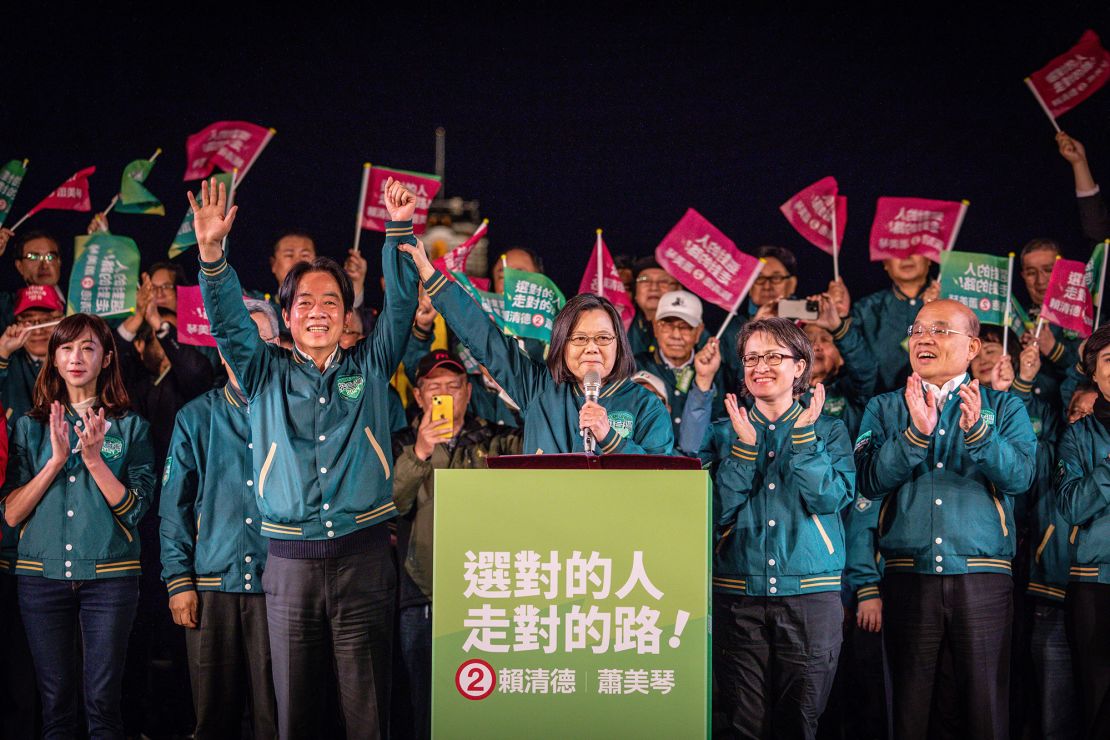
Tsai holds up Lai's hand at a DPP campaign rally in Taipei just days before Taiwan's presidential election on January 13, 2014.
An unconventional politician
Tsai is an unconventional politician in Taiwan. Reserved by nature, she cut a quiet figure in a boisterous democracy known for its festival-like rallies and emotional political speeches. She never married or had children and is an animal lover whose beloved pets frequently featured on her social media accounts, something that endeared her to many young people.
She used to be so shy that she would lower her head to avoid meeting people’s eyes when walking down the street, Wellington Koo, her national security advisor, said in Taiwan in Transition, a documentary on Tsai’s presidency. In another documentary, Invisible Nation, Tsai admitted she never dreamed of becoming a president and dreaded talking to people when she was young.
“I wanted a quiet life. I thought I would become a historian or an archeologist to study things that happened in the past, (because) people that are dead already wouldn’t jump up and argue with you,” she said.
But she ended up studying law and becoming a professor, before working as a trade negotiator for Taiwan and a government minister responsible for China policy. Years working as a non-partisan technocrat imbued her with a “modest, quiet and calm” style of leadership, according to Invisible Nation’s director Vanessa Hope.
Tsai entered politics at 48 years old, when she joined the ruling DPP in 2004. Four years later, the political latecomer faced little competition to become DPP’s chairperson as the party reeled from a crushing presidential election defeat. She first ran for president in 2012, but lost to incumbent Ma Ying-jeou from the Kuomintang (KMT).
She succeeded at the second try, making history not only as Taiwan’s first woman president, but also one of the first women in Asia elected to top office without hailing from a political dynasty.
“People always think that I’m a very cold person,” Tsai said in Invisible Nation. “But the day I was elected president, that was the most emotional moment in my life.”
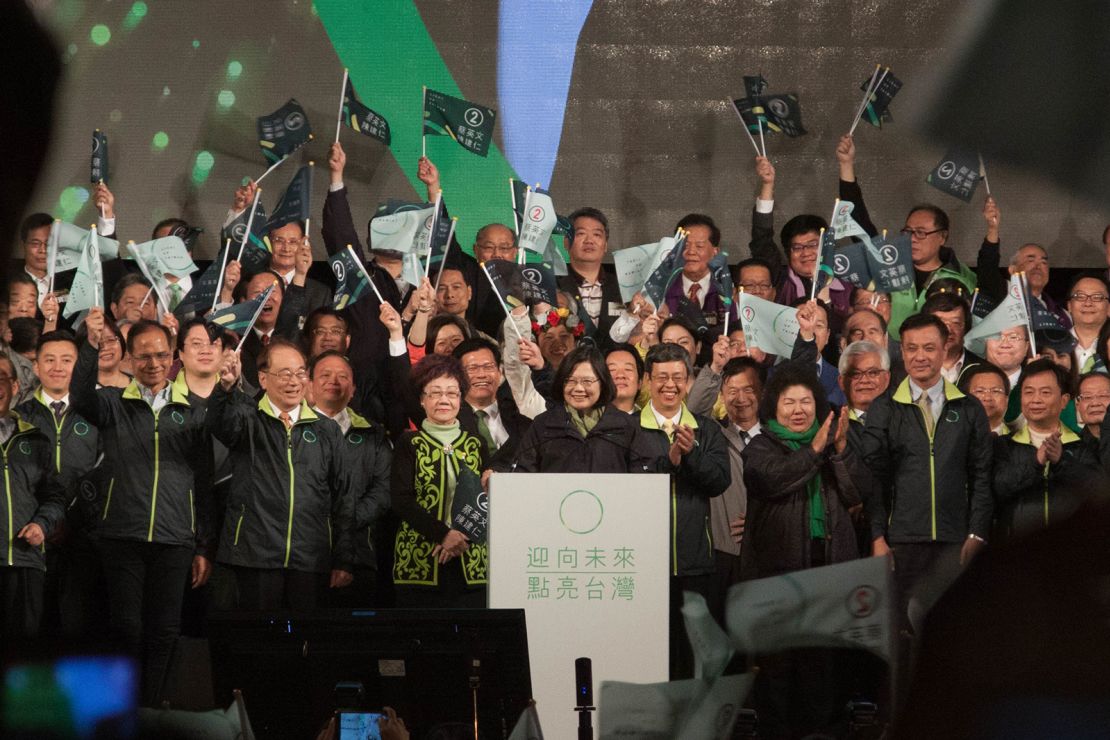
Tsai was elected Taiwan's first female president on January 16, 2016.
‘Put Taiwan on the map’
Since Tsai took office, Taiwan has been caught in an intensifying battle for dominance between China and the US, a global pandemic and the geopolitical and economic fallouts from raging wars in Ukraine and Gaza.
Through it all, the island has boosted its international standing and recognition, bolstering its role as a key democratic partner and an indispensable link in the global microchip supply chain.
In 2019, Taiwan became the first Asian jurisdiction to legalize same-sex marriage. In the early days of the Covid-19 pandemic, it won international praise for its exemplary response and efforts to help other countries, despite its exclusion from the World Health Organization (WHO). Taipei has also enjoyed a surge of international backing from like-minded partners, including the US, Japan and the Czech Republic.
“She’ll be known as the one who put Taiwan on the map internationally,” said Wen-ti Sung, a Taipei-based fellow with the Atlantic Council’s Global China Hub.
During China’s rapid rise to become the world’s second-largest economy and a major power, Taiwan had at times found itself something of an afterthought. Now, the island’s strategic importance – it is the world’s largest producer of advanced semiconductors – has thrust it to the center of geopolitical calculations, with peace and stability in the Taiwan Strait becoming a matter of global concern.
Amid hardening global fault lines, Tsai worked to strengthen ties with the US during both the Trump and Biden administrations. The two sides bolstered economic cooperation, reciprocated high-level political visits and expanded US arms sales to Taiwan. Support for Taiwan has become one of the few issues of bipartisan consensus ahead of the US presidential elections.
“We have seen a normative shift in the way that Western governments talk about Taiwan, in ways that legitimize its sovereignty,” said Amanda Hsiao, senior China analyst for the International Crisis Group.
“US-China competition and Russia’s invasion of Ukraine were also factors that accelerated this trend. But she took advantage of the geopolitical winds.”
Despite tightening ties with its most important security guarantor, the island lost 10 diplomatic allies to Beijing during Tsai’s tenure. It has also been excluded from the WHO’s annual assembly since 2016, losing its previous observer status since Tsai took office.
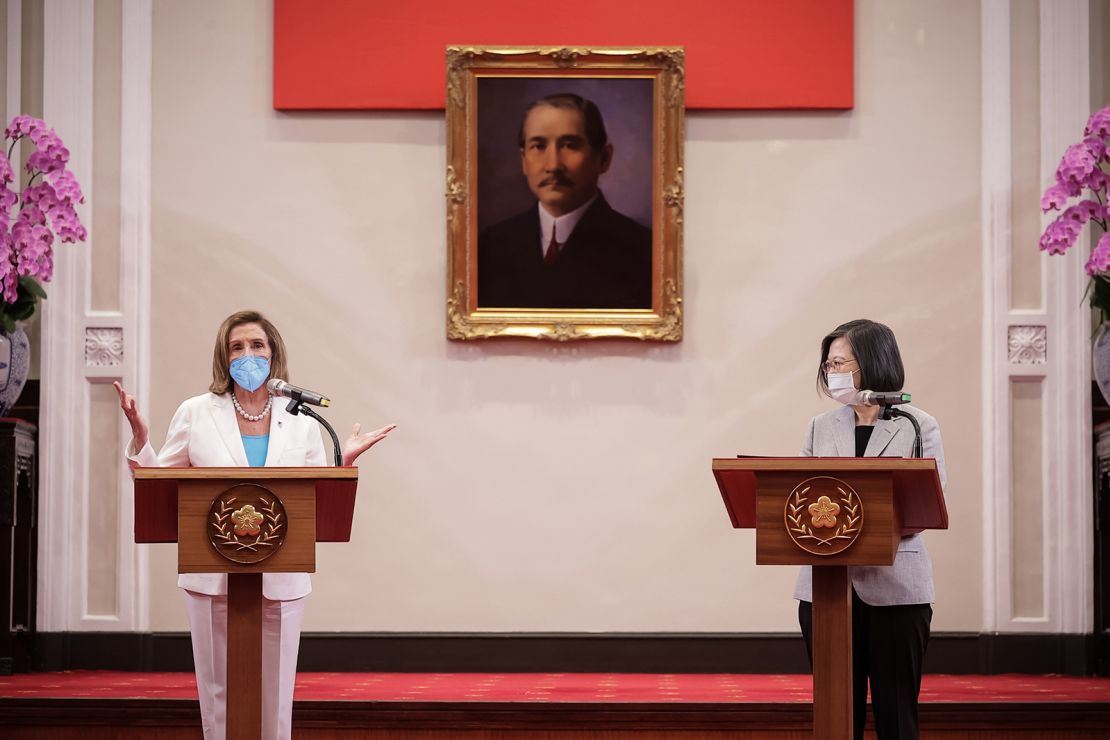
Former US House Speaker Nancy Pelosi gives a speech after receiving Taiwan’s highest civilian honour from Tsai at the presidential office on August 03, 2022 in Taipei, Taiwan.
Standing up to China
Poaching Taiwan’s dwindling number of diplomatic allies and blocking it from attending the World Health Assembly as an observer is widely seen as part of Beijing’s efforts to pressure Tsai into toeing its political line. Unlike the opposition KMT, Tsai and the DPP have refused to endorse the so-called “1992 consensus” that both Taiwan and the mainland belong to “one China,” but with different interpretations of what that means.
Beijing, which deems the tacit agreement a precondition for dialogue, has cut official contact with Taipei since Tsai took office. In addition to the diplomatic squeeze, Xi has ramped up economic and military coercion, slapping tariffs on Taiwanese imports and routinely sending warplanes close to the island.
Tensions came to a head in August 2022, when China fired missiles into waters around Taiwan and simulated a blockade with fighter jets and warships to show its displeasure with then US House Speaker Nancy Pelosi’s visit to Taipei.
But Tsai also maintained a deliberately cautious stance, avoiding provoking Beijing with endorsement of Taiwan’s formal independence, something many in her party openly favor and advocate for. Instead, she argued that Taiwan, officially known as the Republic of China, is already “an independent country” and therefore has no need to declare independence.
Analysts say Tsai moved the DPP’s position on cross-strait relations closer to the center of politics in Taiwan, from a more fiercely pro-independence stance.
Polls show growing numbers of Taiwanese – especially young people – view themselves as distinctly Taiwanese and have no desire to be part of China. Less than 10% now support an immediate or eventual unification, and only 3% identify primarily as Chinese – while 67% see themselves as primarily Taiwanese.
But Huang Kwei-bo, professor of diplomacy at Taiwan’s National Chengchi University, criticized Tsai’s pivot toward the US at the expense of ties with China.
“Taiwan needs to work closely with the US…but it would be unwise of Taiwan to lose political communication channels with Beijing,” he said, noting that Taiwan can’t simply rely on deterrence or military operations to defend itself.
“Maintaining political relations with Beijing is another necessary approach to better security for Taiwan,” he added.
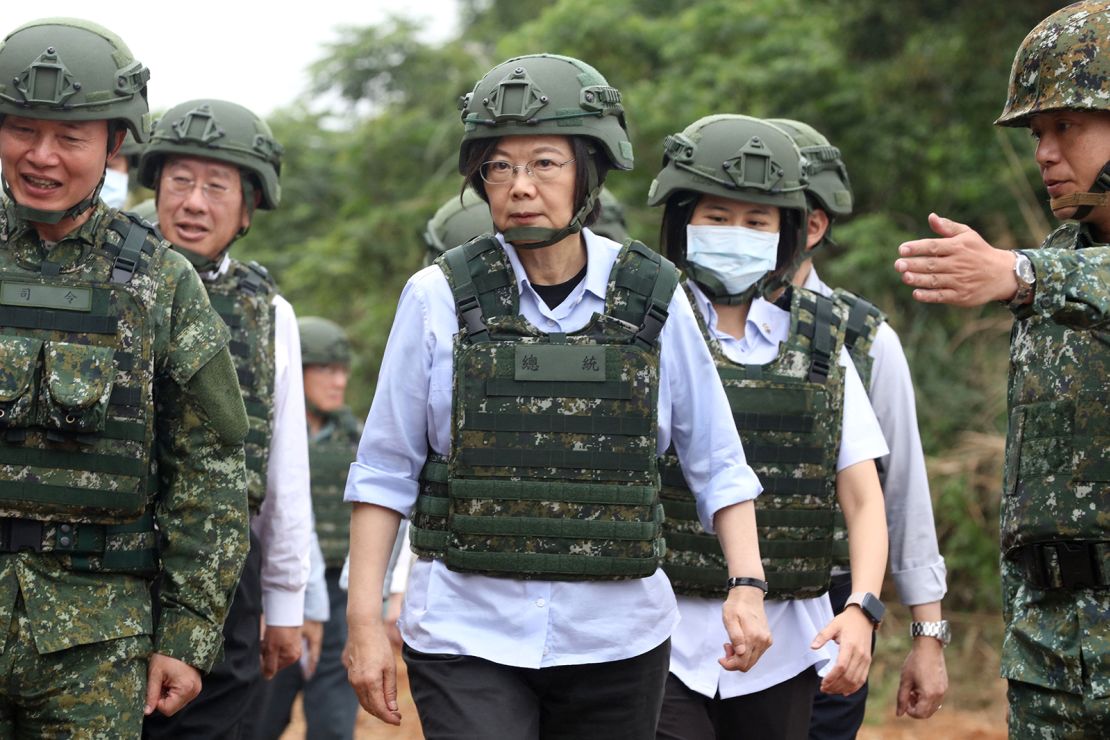
Taiwan President Tsai inspects reservists at a training session at a military base in Taoyuan on May 11, 2023.
Defense reforms
Weeks after Tsai was sworn in, she attended a graduation ceremony at Taiwan’s Military Academy and delivered a stern message: “Our armed forces need to be reformed in a big, bold way…We also need to reform our national defense systems and culture.”
Since then, she has often shown up at military events, sometimes donning bulletproof vests and helmets among soldiers – challenging prejudices that question women’s ability to command the military.
Over her tenure, Tsai has boosted military spending, extended mandatory military service from four months to a year and accelerated the development of its indigenous weapons program to boost combat readiness, including the island’s first domestically produced submarine. These developments “give confidence to Taiwan’s security partners in terms of the island’s determination for its own fair share for providing its own security,” Sung said.
Taipei has also been talking with Washington to establish a “contingency stockpile” of munitions on Taiwanese soil. The US is bound by law to supply Taiwan with weapons to defend itself, and for decades the Taiwanese military has been purchasing fighter jets and missiles from Washington.
But under Tsai, Taiwan has sought to enhance its asymmetric defense capabilities, developing and procuring cheaper and more mobile weapon systems that could be instrumental in halting a potential Chinese invasion.
Taiwanese military experts have increasingly advocated for such an approach, noting that Taiwan can never match China in military might and assets. Despite the increases, Taiwan’s defense budget is still dwarfed by that of China, accounting for less than 10% of Beijing’s military spending.
But Taiwan can still make itself an enormously costly place for China to try and overrun without having to match its far larger, wealthier neighbor. The war in Ukraine has shown Taiwan the effectiveness of portable missiles and drones on the battlefield in fending off a more powerful enemy, experts say.
“The international environment shifted and that contributed to this awareness in Taiwan of how close war could be,” Hsiao said. “Tsai opened the door to defense reform and the idea that defending Taiwan requires a whole-of-society effort.”
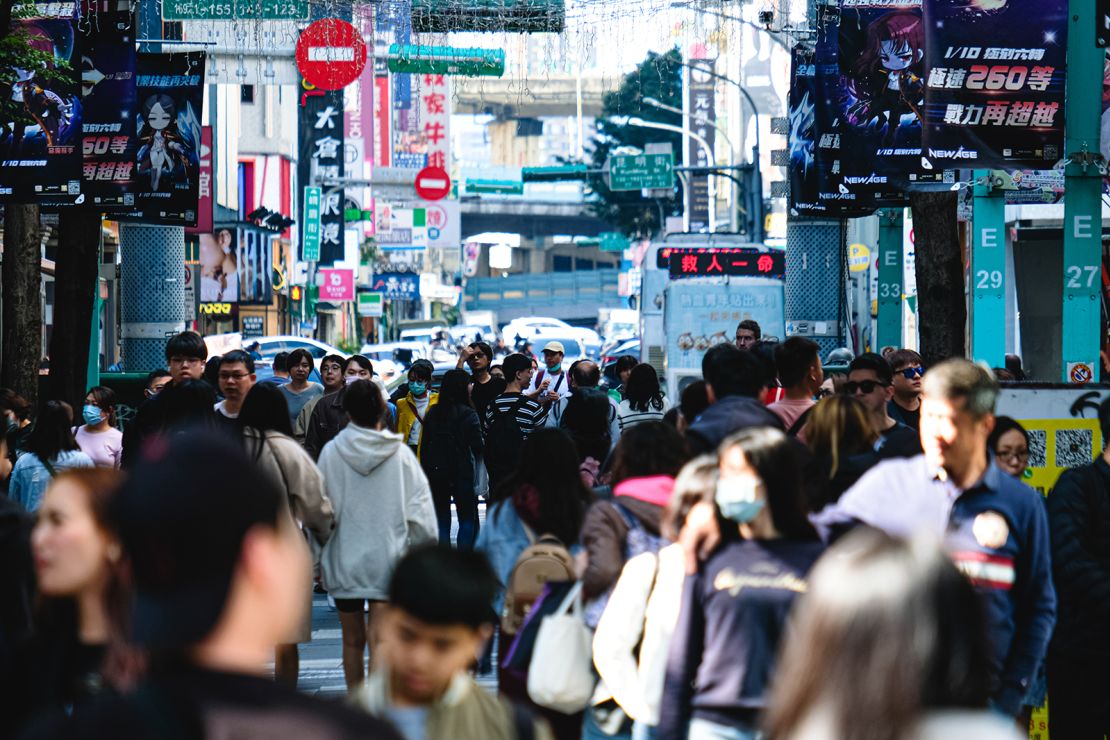
Taiwan's workers have long grapple with low wages, unaffordable housing and high cost of living.
Domestic challenges
Tsai has also left a mixed domestic legacy.
Her push to legalize same-sex marriage angered conservatives, especially in rural regions, but made Taiwan the envy of LGBTQ communities across Asia. This week, days before stepping down as president, Tsai invited Taiwanese drag queen Nymphia Wind to perform the first ever drag show at the presidential office, following her win on hit TV series “RuPaul’s Drag Race” last month.
Tsai has also sought to revitalize economic growth and address social inequality, nurturing emerging industries such as renewable energy and launching pension reforms. During her tenure, Taiwan’s economy grew at an average rate of over 3%, but many residents say the economic benefits are little felt in their everyday lives. Instead, Tsai’s administration has faced mounting discontent over stagnant wages, skyrocketing housing prices and cost of living.
She has also been criticized for sluggish judicial reforms, failure to rein in online scams and a plan to phase out nuclear energy, as well as not going far enough in implementing transitional justice and promoting indigenous rights.
“Under her reign, there has been a squeeze on airtime for more local and bread-and-butter issues,” said Sung. “And you see this reflected in the election results as well.”
Tsai’s DPP suffered huge losses in two mid-term elections, where local issues normally trump national security as voters’ primary concern.
Near the end of her first term, Tsai’s approval ratings plummeted and her chance for a second term was looking increasingly uncertain – until pro-democracy protests erupted in Hong Kong in 2019 against Beijing’s tightening grip. She campaigned heavily on promises to not allow Taiwan to become another Hong Kong, and received a landslide victory.
In January’s presidential elections, public grievances over livelihood issues became a focal point of criticism against the DPP, splitting votes – especially from young people – to a third-party candidate who promised a more “scientific and pragmatic” approach in addressing those issues.
The DPP also lost its majority in the national legislature, leaving more potential political gridlock for the incoming Lai administration to push through policies and legislation.
As Tsai hands the baton to Lai, analysts say it might still be too early to draw conclusions on her legacy.
“How we ultimately judge her legacy will depend on what happens in the next administration as well, as in what they do with what Tsai has achieved,” Hsiao said.
By CNN