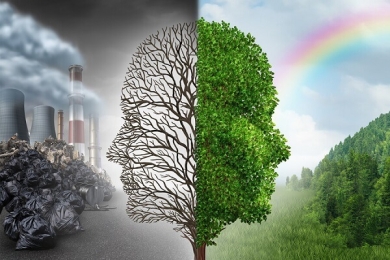
Ancient concepts of the relational interdependence of humans and nature are being revived.

Jonathan Zawada for Noema Magazine
One indication that we may be approaching “peak Anthropocene” is that philosophical quests across the world are coming to regard human-centric modernity as a fraught detour in the long course of life on planet Earth.
Paradoxically, the present crises from climate meltdown to pandemics emerging out of the microbial universe are prompting meditations on the future which harken back to premodern understandings that have gained a fresh resonance.
This renewal of old sensibilities under current conditions was explored recently in a fascinating symposium hosted by Berggruen Institute China at Peking University. Its proceedings have just been published in English under the title “Gongsheng Across Contexts — A Philosophy of Co-Becoming.” (Palgrave Macmillan, 2024)
Gongsheng, as BI China Director Bing Song explains in her summary introduction, derives from the biological concept of symbiosis in which organisms are not singular entities of defined individuality, but can only “live together” in co-dependence, the generative thriving of each conditioned by the other.
Translating this notion into philosophical terms, she writes that the traditions of “Confucianism, Daoism and Buddhism all contributed to the modern notion of gongsheng, which speaks to the conviction and the worldview of mutually embedded, co-existent and co-becoming entities. The notion of gongsheng, shaped by these traditions, behooves us to question the validity of the notion of an individual being as a self-contained and autonomous entity and reminds us of mutually embedding, co-existent and entangling planetary relations. It also inspires within us reverence and care toward creatures, plants and other co-inhabitants and even inorganic things in the natural surroundings.”
Gongsheng is rooted in the common ontology, or foundational belief about the nature of being, of all three ancient philosophies. In Confucian thought, alignment with the natural order of the cosmos, of which humans are an indivisible part, is the ethical basis for a harmonious society. Daoism posits the “oneness of all being,” in which opposites co-exist and determine each other. Buddhism sees that forms and appearances, not least the individual, are an illusion that disguises the unity and “dependent origination” of all phenomena, which are inextricably connected.
Legitimate Individuation
In her introduction, Song looks to where in the West a comparable sensibility has arisen. She lands on the idea of “convivialism,” which, in its Latin provenance, means “to live together.” The idea has been promoted most recently by the French thinker Alain Caillé and the associated movement inspired by its political philosophy.
“Convivialism,” Song writes, “proclaims that relationality and sociality are the essence of humanity and human society.” Indeed, the subtitle of the movement’s manifesto is: “A declaration of interdependence.” Its stated aim is to dismantle what it calls the illusive “neoliberal” ideology of the independent individual as master of the human and natural domain.
Yet, as Song points out, while Chinese philosophy and Western convivialism similarly embrace the reality of interdependence, different social and political calibrations arise from their divergent foundations.
Gongsheng, says Song, “is based on an ontological assumption of a primordial connectivity and oneness of all forms of beings. Confucian ethics has taken this primordial relationality into the social and political spheres using the clan structure and family relationships as the meta-prototype for social and political governance.” Indeed, the structural expression of gongsheng in Chinese history is what the scholar Pan Wei describes as the Middle Kingdom’s “institutional civilization” where the collective will and interests subordinate any emphatic individualism.
Song goes on to observe that “while modernization and Westernization in the past 150 years have infused the narrative of liberal values of individualism, free choice and self-determination into the global public and political discourse, people in the East Asian societies continue to be deeply shaped by the time-honored values and practices in their personal, familial, social and even political lives. They have been constantly oscillating between the world of modernity and that of ancient cultures.”
Convivialism tries to split the difference. “Legitimate individuation,” another movement manifesto reads, “allows each individual to develop their individuality to the fullest by developing his or her capacities, power to be and act, without harming that of others, with a view toward equal freedom. Unlike individualism, where the individual cares only for oneself, thus leading to the struggle of all against all, the principle of legitimate individuation recognizes only the value of individuals who affirm their singularity in respect for their interdependence with others and with nature.” As Song notes, they even assign subjectivity to other species in their thinking.
Incarnation Vs. Institutions
One of the earliest proponents of what he called “conviviality” back in the 1960s and 70s was the fallen, but still faithful, priest and philosopher Ivan Illich. He defined conviviality as “autonomous and creative intercourse among persons, and the intercourse of persons with their environment. … I consider conviviality to be individual freedom realized in personal interdependence and, as such, an intrinsic ethical value.”
This emphasis on individual freedom as a unique constellation within relational interdependence marks the point of departure with Eastern philosophy. One suspects this difference derives from the monotheist concept of one personal god in the Judeo-Christian tradition and, especially in Christianity, the embodiment of the Holy Spirit through the incarnation.
For even the most secular philosophers, such as Jurgen Habermas, the benchmarks of Western civilization — liberty, conscience, human rights, democracy — remain rooted in this Judeo-Christian heritage.
Curiously and critically, in Illich’s case, the philosophy of conviviality led to a directly opposite path from China’s institutionalization of gongsheng. For Illich, institutions, including the Catholic Church, corrupt the intimate personal experience of the incarnate sharing of encompassing being. As a social technology, institutions do so by substituting the relational nexus that constitutes the person with reified individuals, cut adrift from their wholeness to be collectively managed by strangers as cogs in a regime of de-personalized dogma.
Illich carried his critique across the entire institutional landscape of modern society. It was perhaps with respect to the concept of health that he was most radical. He decried “the sacralization of ‘a life’” dis-embedded from the oneness of Life and fetishized as a detached immune system to be managed from sperm to worm by the “brave new biocracy” of modern medicine.
He spoke of “iatrogenic illness” — illness caused by the “bureaucracy” of physicians who abandoned the ancient idea of health as “balance” within the environment in which a person lived. Such a healthy balance could not be achieved, he argued, in an unhealthy environment poisoned by untamed industrial growth.
Beyond a certain threshold, Illich argued, institutionalized social endeavors that defy the reality of relational interdependence become counterproductive to their purpose of improving well-being. “By breaching the limits set on man by nature and history, industrial society engendered disability and suffering in the name of eliminating disability and suffering,” Illich wrote. “The warming biosphere is making it intolerable to think of industrial growth as progress; now it appears to us as aggression against the human condition.”
For Illich, the realization of the “art of living with others” in the awareness of mutual embeddedness and co-becoming is better found in the free and spontaneous association of persons than in the impersonal ordering of institutions.
Symbiotic Learning
Song acknowledges that, while the notion of gongsheng does recognize and celebrate differences, “there is nonetheless a general shortage of intellectual resources for robust individuality or personal rights against the authorities, and thus there may be much to learn from this notion of legitimate individuation and related practices.”
One starting point could be the intersection of Illich’s “intrinsic ethical value” of personal autonomy realized within interdependent relations and the Confucian emphasis on virtuous living, self-cultivation and self-rectification as ways to align with the harmony of the natural order.
“While the parallels between notions of convivialism and gongsheng form a basis for dialogue and mutual intellectual reinforcement, the differences will spur reflection, learning and adaptation,” hopes Song. In this sense, a “symbiotic interaction” between the two notions will be a productive and meaningful contribution in charting a path beyond the Anthropocene.
BY NATHAN GARDELS - NoemaMag