Mending the “metabolic rift” of capitalism.

Jonathan Zawada for Noema Magazine
Decades after the supposed end of Japan’s “lost years,” the country remains on the cusp of degrowth. Its GDP expanded by a mere annualized rate of 0.1% in the last quarter of 2022.
While most economists thus regard Japan as the sick man among the advanced nations, Kohei Saito considers the trajectory of degrowth exactly where a healthy society ought to be headed when the world is heating up from overconsumption.
Saito is the 36-year-old author of “Capital in the Anthropocene,” which embraces degrowth as the way out of the climate crisis and anxieties of incessant competition that have driven so many sararīman to exhausted despair. Though an unfashionable Marxist, his book clearly hit a nerve, especially among the young, selling more than half a million copies in Japan.
This historically frugal island nation that emerged in ancient times from what philosopher Takeshi Umehara called “the civilization of the forest” would seem more fertile ground than most for Saito’s radical message to take root. Going back to the Edo Period of the late 1600s, the Tokugawa Shogunate recognized the ecological crisis of deforestation caused by the extensive use of wood for building. It severely restricted logging and massively planted trees to reforest the landscape. And, of course, the first international effort to stem global warming was called the Kyoto Protocol.
The Shinto and Buddhist sensibility that reveres nature as the oneness of all being is still evident in the gardens and shrines that punctuate the ugly concrete sprawl of rapid postwar modernization that spread everywhere during the 1950s and 60s.
It was in that period that the architect Fumihiko Maki and others launched the “metabolism movement,” which sought to integrate traditional spatial patterns into the design of megastructures and borrow ideas from the adaptive capacities of organic biology as a way to cope with the mushrooming density and congestion of hyper-urbanization.
Intuitively, they already understood in those days that the unprecedented scope of metastasizing development required a response that looked toward natural forms and systems.
Metabolic Rift
It is not so surprising then that it is a Japanese thinker as well who has retrieved the theory of “metabolic rift” from the more obscure works of Karl Marx. The concept is at the core of Saito’s effort to greenify the red hues of historical materialism.
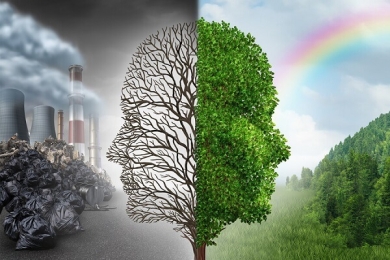
According to Saito, Marx saw the interaction between the human species and its natural environment as “the basis of living.” By turning “nature” into a commodified resource to feed economic growth, capitalism splintered the balanced unity between human and nonhuman beings. That split is now manifested in the Anthropocene where the entire planet has been so transformed by this prevalent mode of production and consumption that the Earth’s livable biosphere is threatened.
For Saito, only a steady-state economy that foregoes the relentless reach for more growth and recovers the natural world as a public commons can mend the rift Marx identified. This reading would place the old master thinker of the Industrial Revolution in the ranks of later “era of limits” apostles such as Ivan Illich. The self-described archeologist of modern certitudes preached the “virtue of enoughness” and contrasted the convivial interdependence of social and natural relations with the ideology that perpetually contrives new markets by transmuting wants and desires into “needs.”
The Idolization Of GDP
What might postmodern degrowth look like in a place where the small spaces in which people keep their distance are dwarfed by Godzilla-scale towers that even these days are rising ever higher in inverse proportion to the shrinking population, where food portions may be trifling but everything from individual grapefruits to bento boxes are packaged in plastic? Saito’s views are downright heretical in the context of how Japan has measured its postwar success.
“We’re preoccupied with GDP ranking and growth, but GDP is a poor measure of a nation’s well-being and happiness,” Saito says. “Here in Japan, we have delicious food, the world’s longest lifespans, safe streets, and excellent public transportation, not to mention the considerable attractions of our culture and art. These assets aren’t reflected in GDP. The adoption of value indicators unrelated to GDP would be a positive step toward degrowth by itself.”
This is a point well taken, though one can’t help but acknowledge that what differentiates the quality of life in Japan Saito cites from the decay and stagnation of a place like Cuba is the inheritance of capital accumulation.
For his own part, and true to his civilizational heritage, Saito has joined with other citizen activists to create the Common Forest Foundation that purchased land around Mount Takao near Tokyo to save the “public good” of forested areas from commercial development.
The Planet Vs. The Mode Of Production
I met Saito in Tokyo last week at the ceremony for the Berggruen Philosophy and Culture Prize awarded to another, much older, Japanese philosopher: Kojin Karatani.
In his seminal work, “The Structure of World History,” Karatani flips Marx’s core tenet that the economic “mode of production” is the substructure of society that determines all else. He postulates instead that it is the ever-shifting “modes of exchange” among capital, the state and nation which together shape the social order.
For Karatani, historically cultivated norms and beliefs about fairness and reciprocity, including universal religions, compel the state to regulate inequality within the mythic commonality of the nation, thus tempering the logic of the unfettered market.
Despite modernizing on the Western model, the Shinto notion of “kami” — the inhabitance of spirit in everything from mountains to objects of human artifice — still echoes in Japanese culture. Perhaps as a result of being steeped in that animist resonance, Karatani’s original interpretation of Marx is that he did not so much materialize the idealism of Hegel’s “world spirit” as he saw “capital as spirit” vitalized by labor.
Marx’s main contention was that breaking the shackles of labor’s alienation from what it produces would be the motor of history that culminates in the realization of the world spirit. In Karatani’s concept, it is the dialectic of contradiction and resolution within his interacting modes of exchange that carries the spirit of world history along.
Saito challenges Karatani’s concept of modes of exchange because it does not incorporate their entwinement with the Earth’s ecosystem. At this historical juncture, he argues, it is, above all, the capitalist imperative of growth that is on a collision course with the planetary imperative of averting climate calamity. Thus, “if we want to properly analyze human interaction with the natural world,” he says, “it is necessary to focus on the site of production again.” As the less-known Marx understood in his idea of metabolic rift, it is the mode of production that alienates the species from the basis of living.
For Saito, the clash and reconciliation of these dueling imperatives will drive history going forward, just as Marx saw class struggle and Karatani sees the interplay of his modes of exchange doing so. In the Anthropocene, social and natural history have become fused and can no longer be divorced from each other. To put it in Hegelian terms, the unfolding of the world spirit is the realization of planetary reason.
Like Illich, Saito warns against the illusion that humans can escape the limits of our condition through a technological fix that somehow accommodates both “sustainability” and “development.” Inexorably, technology harnessed to the logic of GDP growth only further propels and accelerates the ruinous course we are already on, not departs from it.
The alternative to further empowering the GDP bulldozer would entail regarding the planetary ecosystem as a finite commons to be conserved instead of a resource to be endlessly exploited, and in which human flourishing is defined less by well-having than well-being.
It is a measure of how far we have strayed from an ecology of mind that such a vision seems impossibly utopian, even as we know that resolving the planetary predicament must take us in that direction.
Correctly grasping the dynamics that will frame our choices is the best guide to navigating the contours of the future now coming into view. In this, Saito’s perspective is a signal contribution.
BY NATHAN GARDELS - NoemaMag