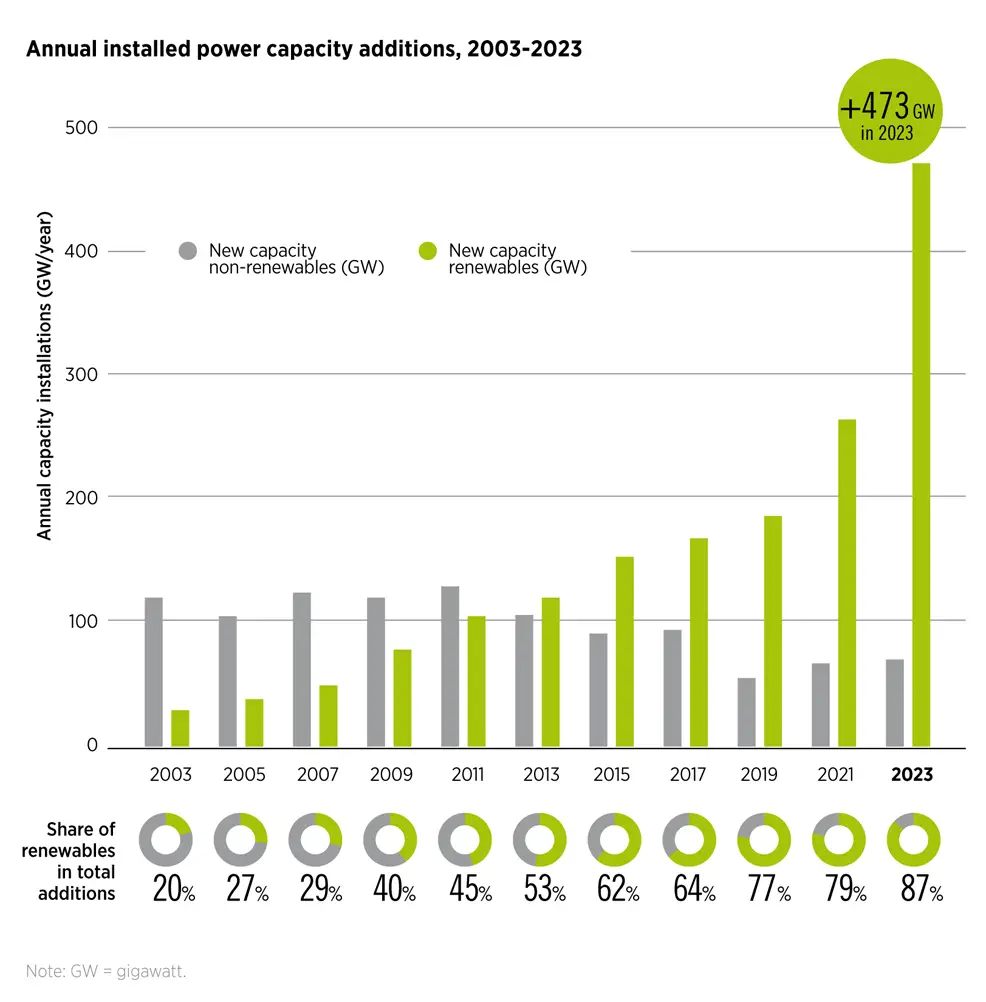
Renewables accounted for 87% of new power capacity installed worldwide in 2023. Despite this record amount of growth, the energy transition remains "off track", according to a report published today.
The International Renewable Energy Agency (IRENA) has released its latest report on the state of renewables. The World Energy Transitions Outlook, available to download here, provides an overview of clean energy capacity additions from 2003 to 2023, while tracking progress towards targets for 2030.
According to the IRENA's analysis, the world added 473 gigawatts (GW) of renewable capacity in 2023, about 62% more than in 2022. Of the total amount of power capacity installed in 2023, about 87% came from renewables, with just 13% from non-renewables.
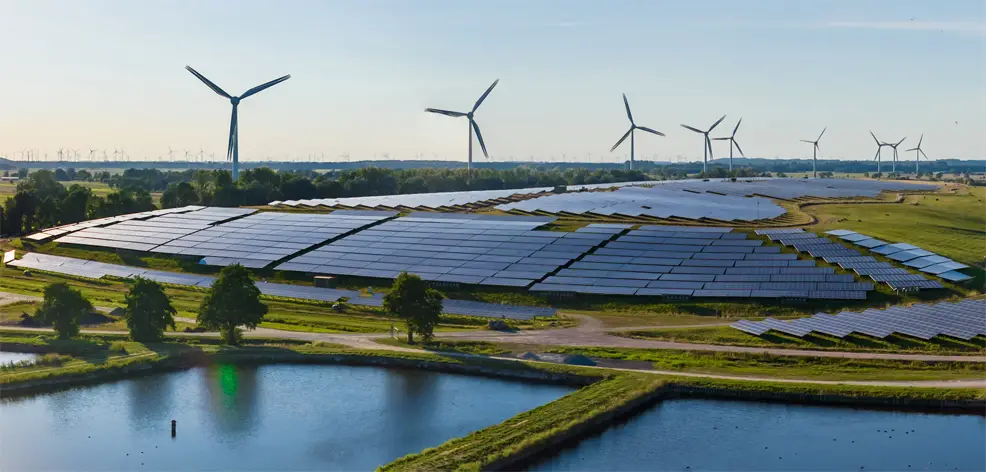
Solar energy made a particularly strong contribution to last year's installations, accounting for 73% of renewables growth. Some of the recent projects to come online have been gigantic in scale – such as the Al Dhafra Solar PV project in the United Arab Emirates. Inaugurated in November, this became the world's largest single‑site solar power plant, covering a 21 sq km (8 sq mi) area of desert. Its four million bifacial solar panels have a capacity of 2 GW, enough to power almost 200,000 homes and eliminate over 2.4 million tonnes of carbon emissions every year.
Al Dhafra Solar PV project. Credit: Masdar
China, the European Union (EU) and the United States dominated the renewable installations in 2023, collectively accounting for 83% of new capacity. China hit another milestone, with 85% of its new capacity originating from renewable sources, driven by the ever-falling costs of utility-scale solar and wind, both of which are now competitive against coal and gas. China's rapid progress in recent years can be attributed, in part, to its supportive energy and industrial policies.
The EU achieved a 37% increase in solar photovoltaic (PV) power in 2023, amounting to 56 GW, along with 17 GW of additional wind power compared to the previous year, amid heightened energy security concerns. The bloc is planning to end all energy imports from Russia by 2027.
In the United States, the Inflation Reduction Act has been driving major investment in renewables through a range of tax credits. Offshore wind power looks set to undergo massive expansion. Just one example is the Revolution Wind project. This alone will provide more than 16 times the current offshore wind capacity of the entire country.
Evolving policies, geopolitical shifts, and declining costs have all played a role in the rapid expansion of renewable energy in markets worldwide. At the COP28 climate summit in Dubai last year, nearly 200 countries reached a consensus to "transition away" from fossil fuels, the first such agreement in the conference's 30‑year history.
However, the IRENA report strikes a note of caution and emphasises that even faster adoption of clean energy is required. The COP28 agreement included a goal of tripling global renewable capacity by 2030. While that remains "technically feasible and economically viable" – according to the IRENA – achieving this target is "far from assured" and needs urgent policy intervention.
Of the various clean energy technologies, only solar is currently on track. Wind, hydropower, geothermal, and others will fall short, based on the IRENA's forecast for 2030. The report also includes a projection for electric and plug-in hybrid vehicles. These, too, are predicted to miss their targets. The stock of these vehicles will need to increase from 40 million globally in 2023 to 360 million by 2030.
Despite their considerable potential, developing countries have received disproportionately low levels of renewable energy investment. Although energy transition related investments have reached a record high – surpassing $2 trillion last year – 120 developing nations attracted only 15% of global renewable investment, with Sub‑Saharan Africa receiving less than 1.5%, despite being home to the highest share of energy-deprived populations.
By contrast, fossil fuels are still receiving $1.3 trillion in subsidies each year, equivalent to the annual investment required in renewable generation capacity to achieve a three-fold increase by 2030. A key aspect of the IRENA's scenario for 2030 is that the increase in renewable energy use must be coupled with a corresponding decline in fossil fuel reliance. Both aspects are lagging.
"In the wake of the historic UAE Consensus on tripling renewables at COP28, these capacity additions – despite setting a new record – clearly indicate that achieving the target is far from guaranteed," said Francesco La Camera, Director-General of the IRENA. "As the custodian agency, IRENA monitors related progress across key indicators every year. Our data confirms that progress continues to fall short, and the energy transition remains off track. We urgently need a systemic shift away from fossil fuels to course-correct and keep the tripling goal within reach."
By FutureTimeLines