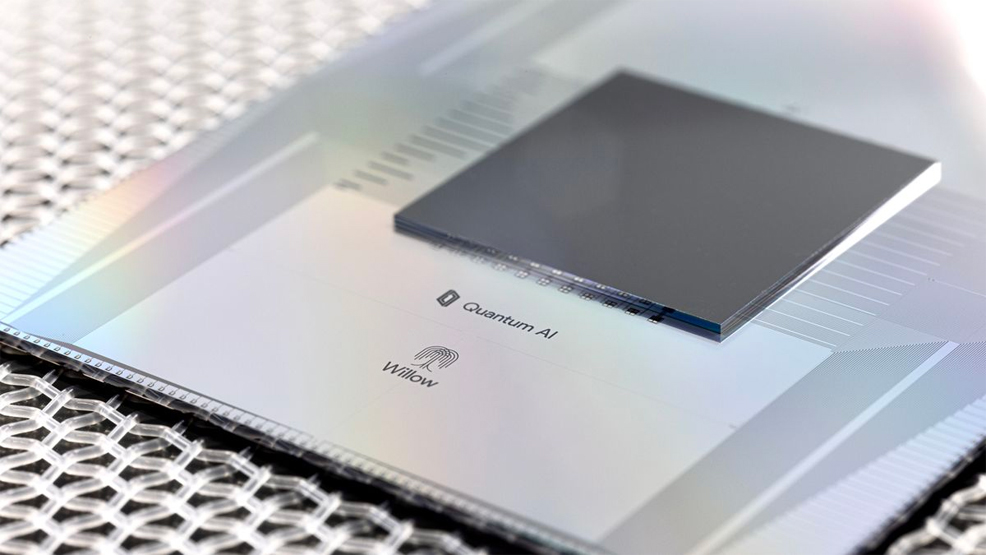
A new quantum chip from Google, "Willow", can perform calculations in minutes that would take classical supercomputers 10 septillion years, marking another leap forward in computational power and error correction.
Quantum computers, once a purely theoretical concept, have increasingly moved from the realm of abstract physics and into practical development, promising to bring revolutionary applications.
Unlike classical machines, which process data in binary bits (0s or 1s), quantum computers utilise quantum bits, or qubits. Qubits can exist in a state of 0, 1, or even both simultaneously, thanks to a quantum phenomenon known as superposition. This capability enables quantum computers to handle a vast number of calculations concurrently, offering hyper-exponential speed gains for specific tasks.
Furthermore, qubits can become entangled, meaning the state of one qubit can instantly influence another, regardless of distance. These extraordinary properties allow quantum computers to tackle certain problems far beyond the reach of classical systems.
Tech giant Google has been involved in quantum computing since 2006. The company's latest innovation is a chip called Willow – successor to Sycamore, which it unveiled in 2019. A paper on Willow appears in the journal Nature this week.
The Willow chip comprises 105 qubits, surpassing the 54 qubits of its predecessor. This near-doubling in qubit count improves computational power and is accompanied by major improvements in error correction – a critical challenge. As quantum systems scale up, they become more susceptible to errors. However, Willow's next-generation design demonstrates that adding more qubits can exponentially reduce these faults, leading to more accurate and reliable calculations.
"Even as we make our quantum chips larger and more complex, by adding more qubits, we can use quantum error correction to actually improve their accuracy," explains Julian Kelly, Director of Hardware for Google's Quantum AI team.
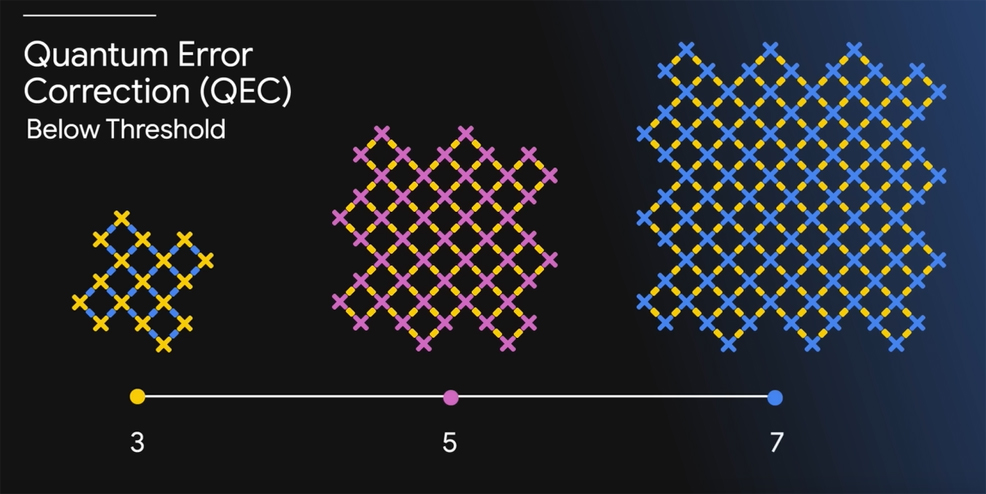
"We tested ever-larger arrays of physical qubits, scaling up from a grid of 3x3 encoded qubits, to a grid of 5x5, to a grid of 7x7 – and each time, using our latest advances in quantum error correction, we were able to cut the error rate in half," said Hartmut Neven, Google Quantum AI founder. "In other words, we achieved an exponential reduction in the error rate. This historic accomplishment is known in the field as below threshold: being able to drive errors down while scaling up the number of qubits. You must demonstrate being below threshold to show real progress on error correction, and this has been an outstanding challenge since quantum error correction was introduced by Peter Shor in 1995."
In addition to reducing errors, Willow has achieved a substantial improvement in T1 coherence times – a measure of how long qubits can remain stable and hold their quantum state before decaying back to their ground state. Coherence times are reduced by environmental disturbances such as temperature fluctuations, vibrations, and electromagnetic noise. According to Google, the Willow chip achieves T1 coherence times that are five times longer than those of Sycamore, enabling its qubits to maintain stability for extended periods during calculations.
Willow achieved phenomenal results when made to compete against one of the world's fastest conventional supercomputers. Using a benchmark known as Random Circuit Sampling (RCS), Kelly and his team found that a calculation requiring five minutes of its quantum processing would take 10^25 years on a classical machine. That is 10 septillion – 10,000,000,000,000,000,000,000,000 years – trillions of times the current age of the universe and nearly five times the half-life of Tellurium-128, which has the longest known half-life of any unstable isotope.
Google has a long-term roadmap that consists of six milestones. Having surpassed an error rate of 10-2 and with 105 qubits, the company is now focused on its next goal of Milestone 3. This will require at least 1,457 qubits and an error rate as low as 10-6. Ultimately, Google plans to reach Milestone 6 – a large-scale, error-corrected quantum computer with a million qubits and error rate of 10-13.
"Willow is the most convincing prototype for a scalable logical qubit built to date," said Neven. "It's a strong sign that useful, very large quantum computers can indeed be built. Willow brings us closer to running practical, commercially-relevant algorithms that can't be replicated on conventional computers."
"Looking to the future with Willow, we continue our journey towards building large-scale and useful, error-corrected quantum computers that will push the boundaries of science and the exploration of nature," explains Kelly. "With future, commercially useful applications in areas like pharmaceuticals, batteries, and fusion power, we are excited so solve the otherwise unsolvable problems of tomorrow."
By FutureTimeLine