As Chinese scientists analyzed the soil samples that their lunar probe brought back from the moon, they realized something groundbreaking: There was water found along with minerals in the soil.
Finding water on the moon is, on its own, nothing new. NASA and Indian spacecraft have spotted what they believe to be water on the moon’s surface, and Chinese scientists last year found water trapped in glass beads strewn across the moon.
But this latest discovery, scientists say, is the first time water in its molecular form, H2O, has been found in physical samples – and, importantly, it was retrieved from a part of the moon where they’d previously thought water in that form couldn’t exist.
Researchers closely inspected samples collected by China’s Chang’e-5 probe, which landed on the lunar surface in 2020, and found a “prismatic, plate-like transparent crystal” – roughly the width of a human hair – that was in fact an “unknown lunar mineral” dubbed ULM-1, according to the study, which published July 16 in the journal Nature Astronomy.
The ULM-1 crystal (with the chemical formula (NH4)MgCl3·6H2O) are made up of roughly 41% water, with bits of ammonia that keep that H2O molecules stable despite wild temperature swings on the moon, according to the study.
This type of water could be a potential “resource for lunar habitation,” the scientists wrote in their study.
The discovery is the latest finding in China’s larger push to become a dominant space power – with sweeping ambitions such as building a research base on the moon. The study was hailed by excited Chinese social media users, who pointed to the space program as a source of national pride.
“The discovery of a hydrated mineral at the Chang’e-5 landing site is fascinating and will further enhance our understanding of rock-vapor reactions in the lunar crust and on the lunar surface,” said David A. Kring, principal scientist at the Lunar and Planetary Institute in Texas, who was not involved in the study.
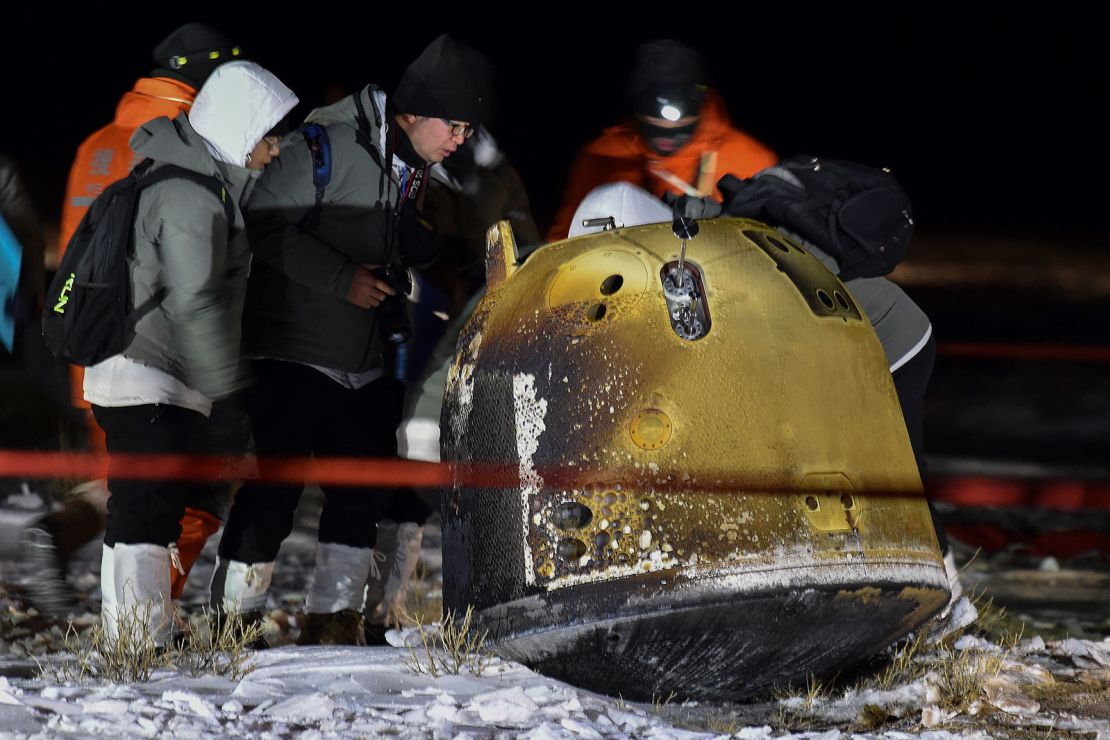
Recovery crew members inspect the Chang'e 5 probe after its successful return landing in northern China in December 2020.
Tough to extract
There are three types of water that can exist on the moon, according to Yuqi Qian, a planetary geologist at the University of Hong Kong, who was not involved in the study.
There are water molecules, the compound we know as H2O; its frozen form, ice; and a molecular compound called hydroxyl, a close chemical relative.
Previous discoveries suggested that water had existed on the moon when volcanoes used to erupt in the ancient past – and that lunar water had come from those volcanoes, meaning it came from within the moon and has been present since the moon’s early existence.
But people didn’t always know there was water on the moon, though scientists theorized about its existence for hundreds of years. At times researchers had believed the moon was dry, particularly after not initially finding water in the samples collected by NASA’s Apollo missions and the Soviet Union’s Luna missions.
It was only in more recent years that scientists found water, ice and water molecules mostly located at the dark, cold lunar poles where the sun doesn’t reach. A recent study has also suggested that water or hydroxyl may be trapped in glass beads strewn across the lunar surface, and that solar winds could transform hydroxyl (chemical formula OH) to form water, or H2O.
But the lunar poles are difficult to navigate because of the rocky terrain, making them challenging locations for humans to extract water. And molecular water is “not stable in other regions of the moon,” vaporizing at lower latitudes where temperatures can exceed 100 degrees Celsius (212 Fahrenheit), said Qian.
This new study changes that.
The samples, retrieved by China’s Chang’e-5 probe, came from a middle-latitude part of the moon, at 43.1 degrees latitude – an area that’s normally “not stable for molecular water,” Qian said. Ammonium was found in the samples, which acted as a stabilizer for the water molecules, he explained.
This mechanism also corroborates NASA’s findings from 2020, when its SOFIA telescope detected the signature of water on the lunar surface – though scientists could not verify this finding with physical samples at the time, or explain exactly how the water was staying on the hot surface.
“I think it has lots of potential, this new finding that we can extract molecular water directly from lunar soils,” Qian said. “I think this is a new mechanism to make molecular water stable on the lunar surface.”
Kring, from the Lunar and Planetary Institute, caveated that though the sample was collected from a mid-latitude area, “it was not clear if it formed there. Impact processes can redistribute rock across the lunar surface.”

An image taken by the panoramic camera aboard the lander-ascender combination of Chang'e-5 shows the moon's surface after the probe's landing.
China’s space ambitions
A growing number of countries, including the United States, are eyeing the strategic and scientific benefits of expanded lunar exploration.
China has made rapid advancements in recent years, reflecting leader Xi Jinping’s “eternal dream” of building the country into a space power.
In 2013, China became the first country to achieve a robotic lunar landing in nearly four decades. Then in 2019, it became the first and only country to land on the moon’s far side. Three years later, China completed its latest orbital space station, the Tiangong.
And it has more planned, aiming to land astronauts on the moon by 2030 and building a research base at its south pole.
Understanding how water is stored on the moon is useful, experts have previously told CNN, because it could point future lunar astronauts toward potential resources that could one day be converted to drinking water or even rocket fuel.
After the latest study, many Weibo users raised the possibility of growing plants or crops on the moon using the molecular water found in soil. But, Qian said, it’s too early to draw those kinds of conclusions. Growing anything on the moon would depend on factors such as how abundant the water is – which requires more research to confirm.
However, he added, “this new phenomenon, this new mechanism … will open the door to (finding) new water in this new form.”
Kring similarly cautioned that the findings so far have “no significant implications for exploration mission architectures, although it demonstrates that discoveries await those who are willing and able to explore the Moon.”
China’s rapid advancements have caught NASA’s attention. The space agency hasn’t been permitted to work with its Chinese counterparts since 2011, when Congress passed the Wolf Amendment citing concerns about espionage.
But last August, China did open up access to the Chang’e-5 samples to the international community.
“We are going through the process right now with our scientists and our lawyers to make sure that the instructions and guardrails that the Chinese are insisting on … are not a violation of the law, the Wolf Amendment,” NASA Administrator Bill Nelson recently told CNN. “As of this moment, I don’t see a violation.”
But such issues have left China barred from the International Space Station (ISS), spurring its efforts to build the Tiangong – which has become a challenger to the US, especially as the ISS prepares to retire in 2031.
These limits on its international space collaboration, and China’s own ascent, have left some Chinese social media users feeling vindicated by the latest discovery – with online comments and state media coverage hailing the advancements of the national space program.
“This is a demonstration of our country’s scientific and technological strength!” one user posted on the Chinese social media site Weibo, where a hashtag about the discovery has been viewed 35 million times.
Another user thanked the country’s space program, writing: “We are at the global forefront in lunar scientific research.”
Others on Weibo urged greater cooperation for the benefit of mankind, pointing out that the study was published in an international journal reviewed by experts from various nations.
“We can’t work behind closed doors – it would be best to attract all of their scientists to China,” one wrote.
By Jessie Yeung, CNN