The new world for which the greatest generation sacrificed in the bloody surf of the Normandy beaches is fading into history along with the last of the old soldiers.
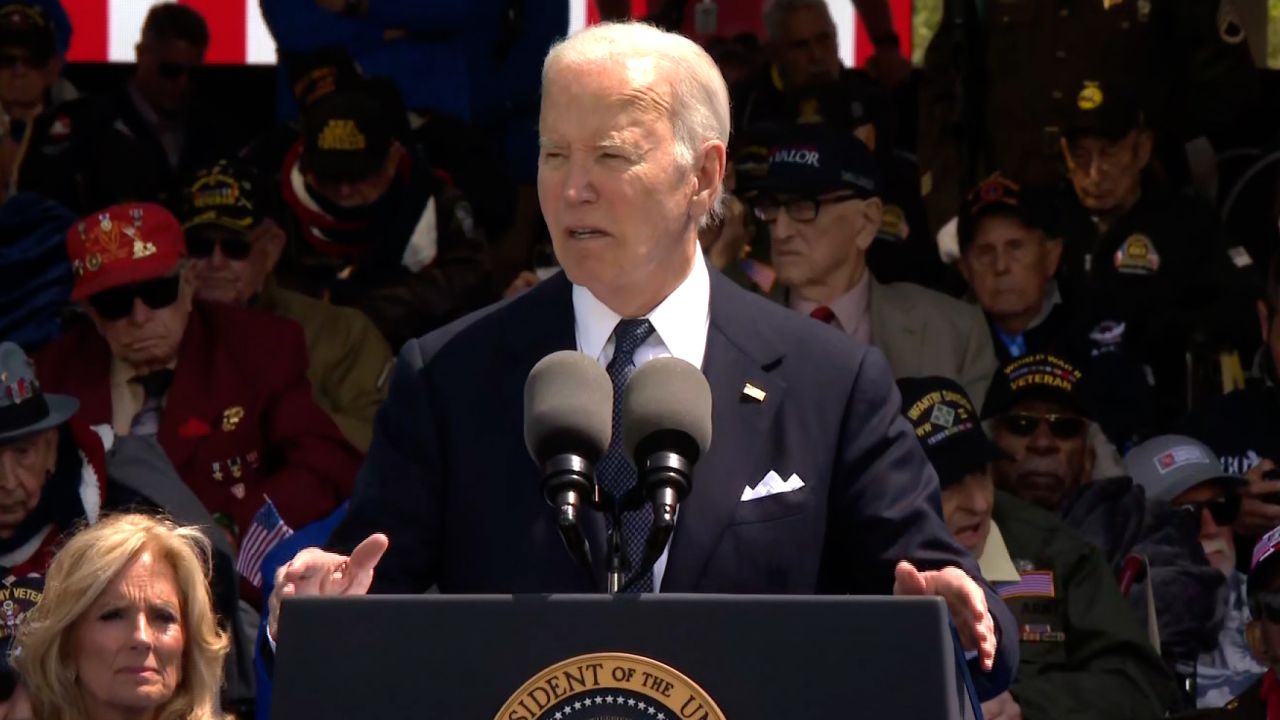
The 80th anniversary of the D-Day landings observed by President Joe Biden in France Thursday will likely be the last major decennial commemoration attended by significant numbers of veterans. Even a 19-year-old who stormed ashore in the biggest amphibious operation in history would soon be 100.
“We’re not far off from the time when the last living voices of those who fought and bled on D-Day will no longer be with us, so we have a special obligation,” Biden said after embracing and saluting the last surviving members of the invasion force, above the beaches where thousands of Americans died.
“We cannot let what happened here be lost in the silence of the years to come.”
This year’s memorial ceremony represents far more than a poignant farewell to surviving comrades of more than 150,000 allied troops who forged a beachhead for the liberation of Europe from Adolf Hitler’s Nazis.
Presidents, prime ministers and monarchs from NATO nations gathered at a paradoxical moment. They are unusually united but experiencing growing dread. The alliance has a new sense of mission in opposing another war started by a tyrant bent on territorial expansion — this time in Ukraine. But at no point since June 6, 1944, has the unshakable US leadership of the West and support for internationalist values been so in question. Democracy is facing its sternest test in generations from far-right populism on the march on both sides of the Atlantic Ocean. Geopolitical empires like Russia and China are, meanwhile, resurgent and threatening to obliterate the global system dominated by Western values that has prevailed since World War II.
Biden drew a direct line between the evil that US soldiers were called up to fight in the 1940s and the current attempt by President Vladimir Putin’s Russia to wipe Ukraine off the map and extinguish its democracy.
“We cannot let that happen. To surrender to bullies, to bow down to dictators is simply unthinkable. Were we to do that, it means we’d be forgetting what happened here on these hallowed beaches. Make no mistake: We will not bow down, we will not forget,” he said.
Those who served in Normandy, Biden said, “all understood our democracy is only as strong as we make it all together. They knew, beyond any doubt, there are things that are worth fighting and dying for. Freedom is worth it, democracy is worth it, America’s worth it, the world is worth it – then, now and always.”
His words were especially resonant amid growing fears in Europe that the United States – the bulwark of democracy ever since World War II – may be about to turn its back on the West.
US allies already rattled by presumptive Republican presidential nominee Donald Trump’s constant attacks on NATO in his first term were further rocked by his recent comment that he’d let Russia do “whatever the hell they want” with allies that he regarded as failing to “pay their bills” on defense spending. The comment weakened the foundational NATO creed of mutual self-defense without which the alliance has no meaning. Some of Trump’s ex-advisers have warned that he might try to exit the alliance if he wins a second term in November. Even if Biden wins, there are growing indications that Americans’ willingness to maintain the security guarantees — even to former enemies like Germany and Japan that bought 80 years of peace — may be waning.
Trump’s “America First” philosophy has taken deep root in the Republican Party that once prided itself on winning the Cold War. The ex-president tried to overturn US democracy to stay in power four years ago. And some GOP figures led by the ex-president now appear to have more empathy for Putin than liberal European democracies that the United States rebuilt after World War II. And the monthslong delay in funding Biden’s most recent aid package for Ukraine raised doubts that Washington will always stand up for democracy in Europe and against aggression by autocrats.
Biden on Thursday cited an unrepayable debt owed to US, British, Canadian and other troops involved in Operation Overlord. He walked among row upon row of white crosses and Stars of David shaded by pine trees and oaks overlooking Omaha Beach. This is where more than 9,000 fallen Americans from all 50 states and the District of Columbia lay at rest thousands of miles from the land they left to save foreigners they’d never met.
When the final survivors of World War II are soon gone, the world will lose living testimony of a fight against tyranny that once involved millions of people and unimaginable pain and destruction. That will usher in a dangerous period when malevolent political actors will find it easier to distort history to bolster their own power. This has already been happening as the lessons of the Nazi Holocaust, from which there are dwindling numbers of survivors to bear witness, have been challenged by a rise in antisemitism in Western societies.
Is America really ‘back’?
Biden took great pleasure in traveling the world after winning the 2020 election and declaring “America is back.” He lived up to his words by wielding the most effective leadership of the Western alliance since President George H.W. Bush at the end of the Cold War. But many foreign leaders worry that Biden’s term is an interregnum of normality rather than a return to the certainty of US leadership. With his volatile temperament, transactional suspicion of alliances and idolizing of dictators, Trump’s first term turned the United States from a bulwark of stability into an unpredictable force of disruption. After a long period of denial, many in the chancelleries of Europe expect Trump to be back.
Trump’s mix of isolationism and populism did not emerge in a vacuum. It was distilled from years of US military failures abroad in places like Iraq and Afghanistan and a growing belief among many Americans that the globalized world was eroding the domestic dividend of prosperity and security that flowed from World War II and was built by those who returned from the battlefields of Europe and the Pacific. A growing sense that Americans are tiring of their global role has sparked overdue debates in some European capitals about doing more to ensure the continent’s own security.
Charles Kupchan, a senior fellow at the Council on Foreign Relations, believes that the internal threat to the West is as great as the external one posed by US enemies. “And it’s not just Trump,” he said. “It’s also what’s happening to the political center in France, the political center in Germany, the likely gains of the far right in the upcoming EU elections. Even if Biden were to win, Americans, Europeans are asking difficult questions about American reliability.”
Success was not assured
The Normandy landings, long regarded as a triumph, marked the moment in history when the United States truly emerged as a superpower with the might and the will to make the world safe for democracy. But at the time, the risk of sending an armada across the English Channel in questionable weather to battle hardened Nazi forces was enormous. As allied forces landed on the beaches, President Franklin Roosevelt uttered a D-Day prayer over the radio. “Almighty God: Our sons, pride of our nation, this day have set upon a mighty endeavor, a struggle to preserve our Republic, our religion, and our civilization, and to set free a suffering humanity.”
To begin with, fears of failure seemed justified. By the end of June 6, none of the invading forces had achieved their first-day objectives. More than 10,000 were dead, wounded or missing. The Supreme Allied Commander in Europe, Gen. Dwight Eisenhower, had prepared a message before the invasion in case of a retreat. “If any blame or fault attaches to the attempt, it is mine alone,” he wrote. But the future president never had to take his remarks out of his wallet. In the days ahead, the allies slowly established a foothold in the northwest tip of the continent. After breaking out, they were in Paris by August and, after often bitter fighting, victory in Europe was won by May 1945.
For many years after World War II, D-Day commemorations lacked the fanfare and high diplomatic and political significance they carry today. And there’s an argument that the geopolitical symbolism has become too heavy and threatens to obscure the simple courage of dwindling groups of veterans who make a pilgrimage to honor slain comrades. But French and American presidents especially have used the gatherings as a stage to renew transatlantic bonds. In an especially significant piece of statecraft this time, the Western leaders will be joined by Ukrainian President Volodymyr Zelensky, who has billed his nation’s fight for survival after the Russian invasion as an echo of the allied battle against Hitler.
Russian leaders or top officials have also attended the commemorations, at least since the end of the Cold War, in honor of the Soviet Union’s staggering losses fighting the Nazis. But Putin is now a pariah and has not been invited.
This year’s event has important domestic connotations for several leaders. It will be the first of the decennial commemorations to feature Britain’s King Charles III as head of state after the death of his mother Queen Elizabeth II, a fixture in Normandy for decades. And it offers a stage for French President Emmanuel Macron and Biden, both politically weakened, to highlight their statesmanship at a moment of global turmoil.
Biden will on Friday echo one of his predecessors, Ronald Reagan, who in 1984 traveled to a clifftop 100 feet high known as Pointe du Hoc, which was scaled in a daring raid by US Army Rangers on D-Day. Despite heavy losses, the Rangers seized German artillery pieces that could have caused even greater carnage of the Omaha and Utah invasion beaches.
Reagan stood in front of a stone memorial shaped into the Rangers’ emblem, with his back to the Channel, surrounded by surviving veterans of the raid, and gave one of the greatest presidential speeches. “These are the boys of Pointe du Hoc. These are the men who took the cliffs. These are the champions who helped free a continent. These are the heroes who helped end a war,” Reagan said. He later confessed to his diary that he was so moved it was tough to get the words out.
The speech came at a particularly contentious moment in the Cold War with tensions high between Washington and the Soviet Union. But Reagan’s clarion call for freedom may have had an impact. Less than a year later, Mikhail Gorbachev became secretary general of the Soviet Communist Party and set in motion reforms and nuclear arms negotiations that led to the end of the Cold War.
Biden, like the 40th president, is facing concerns about his age in his reelection year. And on Friday he will visit the same clifftop to make a similar call to save democracy. Reagan’s Pointe du Hoc speech is not just remarkable for its poetry. Forty years on, it’s stunningly relevant to a new political era. And it’s equally striking how far the Republican Party has traveled from the man who once personified it to the anti-democratic American Firstism of its current hero.
“We in America have learned bitter lessons from two World Wars: It is better to be here ready to protect the peace, than to take blind shelter across the sea, rushing to respond only after freedom is lost,” Reagan said. “We’ve learned that isolationism never was and never will be an acceptable response to tyrannical governments with an expansionist intent.”
He went on: “We are bound today by what bound us 40 years ago, the same loyalties, traditions, and beliefs. We’re bound by reality. The strength of America’s allies is vital to the United States, and the American security guarantee is essential to the continued freedom of Europe’s democracies. We were with you then; we are with you now. Your hopes are our hopes, and your destiny is our destiny.”
In 1984, Reagan could offer that promise without fear of contradiction. Biden cannot do the same in 2024.
By Stephen Collinson - CNN