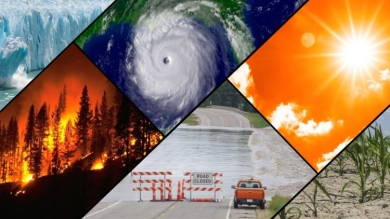
2023 ended without the technical recession economists expected, but their warning of stagflation and a potentially crippling debt crisis should not be easily dismissed
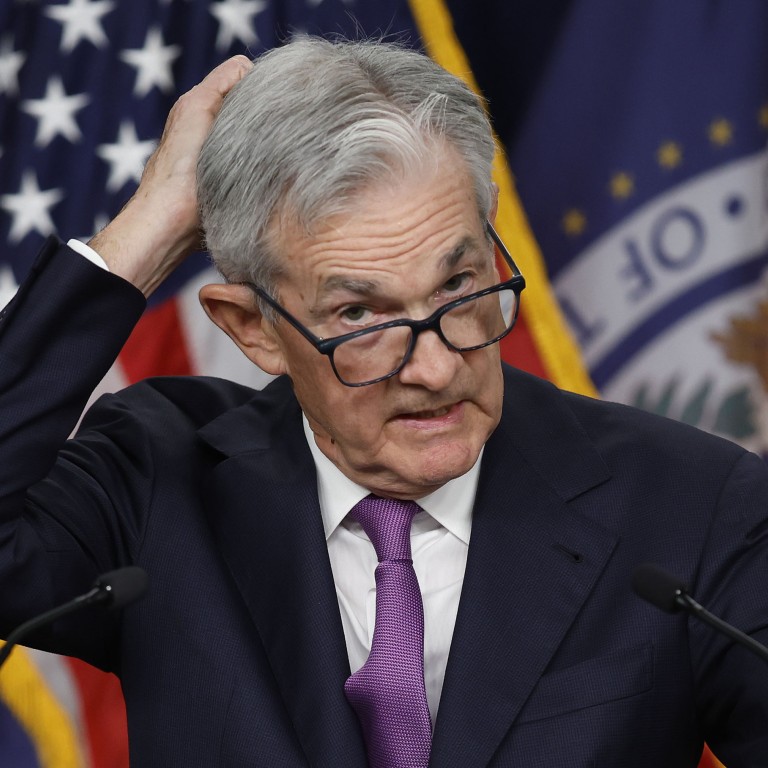
Federal Reserve Board Chairman Jerome Powell at a news conference on September 20. For those expecting a technical recession only in the US, the call was deeply and embarrassingly off target. Photo: Getty Images/TNS
This time last year, the consensus of the world’s leading economists and economic institutions was virtually for a deep recession, continuing into 2024.
By March, economist Nouriel Roubini was warning of “the mother of all debt crises”. “We’re moving from the great moderation to the great stagflationary debt crisis and instability,” he said. In April, the International Monetary Fund judged that “risks are firmly on the downside”.
What has happened since, that forecasters are now predicting a soft landing and perhaps no recession at all? How did the profession so comprehensively misjudge the prospects for the global economy?
First, it remains possible the gloom a year ago was well justified, and a recession still hangs over us. Fears have abated but not gone away. True, the alarming increase in inflation post-pandemic seems to now be under control (at about 3 per cent in the United States, from over 9 per cent in 2022). As a result, anxiety about soaring interest rates, and in particular crippling mortgage costs, has eased.
Second, whether a recession looms depends on where you live and how you define it. For many in Asia, where inflation did not become a systemic problem, the recessionary panic has very much been a US or European problem.
But for those whipsawed by volatile commodity prices and a crippling surge in debt repayment costs, recession has been a cruel reality for longer than the past year.
China’s property crisis has had a recessionary impact but this had little connection with the recession feared by US-based economists. Hong Kong is arguably living through a severe downturn that has little to do with inflation or high interest rates, and more to do with the catastrophic impact of the pandemic on the city’s highly specialised hub and headquarter roles.
The definition of a recession is also significant. It is routinely and oversimplistically seen as any combination of negative forces that results in a two-quarter contraction of gross domestic product. For many analysts in the US, this definition involves short-term threats such as rising inflation, job losses, growing debt service costs and mortgages, a credit squeeze and poor property and stock market performances.
By these criteria, the recessionary threat has been almost triumphantly well-managed. Inflation is sharply down from 2022 peaks, interest rates are high but stable, job creation has remained boisterous, and the stock market has had a superb year – up by over 26 per cent, according to the Morningstar US Market Index.
GDP growth may be slower than liked but stayed firmly positive. High interest and soaring debt service costs may remain a serious threat as debt renewal negotiations fall due, in particular to property companies and indebted homeowners, but for most, these are challenges yet to materialise.
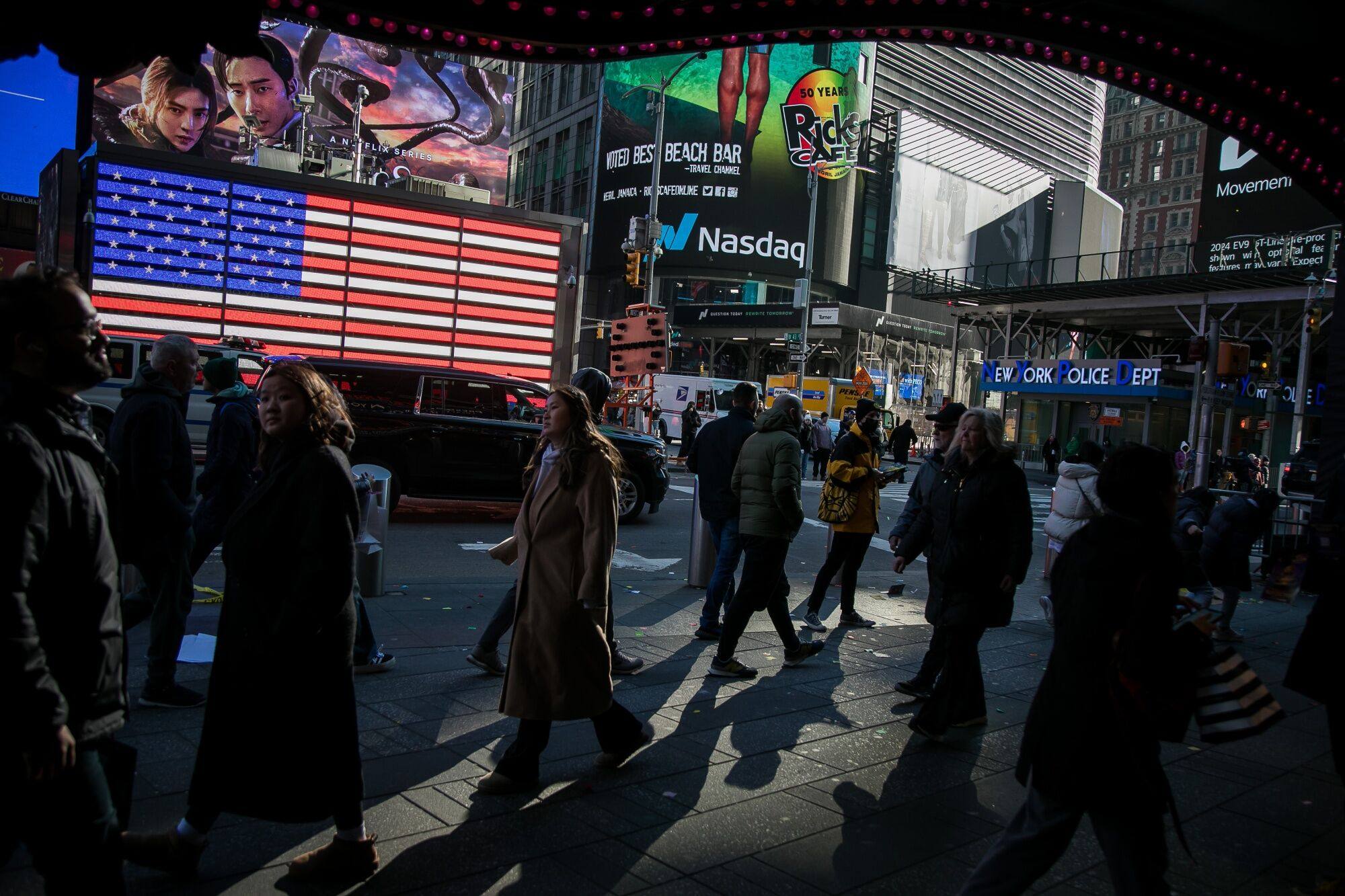
Pedestrians pass the Nasdaq MarketSite in New York, US, on January 2. US stocks have had a stellar year, with the Nasdaq rising by 43 per cent in 2023. Photo: Bloomberg
But when economists like Roubini warn of recession and stagflationary mega threats, they are talking about a broader combination of long-term challenges immeasurably more dangerous than two quarters of falling GDP.
In his book Megathreats, Roubini makes clear he is concerned not just with economic, monetary and financial risks but also with political, geopolitical, environmental, health, technological, trade and globalisation-related ones.
Asked which mega threat concerned him the most, Roubini was clear: “In the short run it is stagflation and debt crisis. Over the medium-long term, I worry about war among great powers and how much destruction it can bring, together with climate change.”
Roubini is particularly haunted by rising debt worldwide, especially the soaring cost of servicing debt in an era of higher interest rates. He notes that debt worldwide (private, household, corporate, financial sector and public) was less than 100 per cent of GDP in the 1970s, but had risen to 200 per cent by 1999, and in 2022 stood at 350 per cent. In advanced economies, it was 420 per cent of GDP and climbing.
According to the Development Finance International’s Debt Service Watch, governments in the Global South are spending 38 per cent of their budget revenue on debt service – equivalent to their combined spending on education, health, social protection and climate. Of these, 35 countries are spending over half of their revenue on debt service.
What so haunts people like Roubini is not just the acute pressure on education and health spending, but that this huge and still rising sum is set to strangle spending on pandemic preparedness, climate change and mitigation – even as pressure grows for higher defence spending in light of conflicts in Ukraine and Gaza.
He is joined by many others anxiously observing what they fear is set to become a global “polycrisis” – a concept recently popularised by historian Adam Tooze as a combination of disparate crises that interact so that the whole is more overwhelming than the sum of the parts, challenging our ability to cope and threatening to “hurtle us towards catastrophic ecological tipping points”.
So what is the verdict? For those expecting a technical recession only in the US, the call was deeply and embarrassingly off target. But for those who share Roubini’s angst over mega threats or polycrisis, the alarm justifiably remains.
As Harvard University’s Jeffrey Frankel noted back in July, this is like a sky diver who jumps without a working parachute. On his way down, a passing hang glider asks how he is doing and he shouts back: “OK, so far!”
David Dodwell is CEO of the trade policy and international relations consultancy Strategic Access, focused on developments and challenges facing the Asia-Pacific over the past four decades
By David Dodwell