A new report forecasts widespread disruption in the creative and entertainment industries due to generative AI over the coming three years.

Generative AI has already made a substantial impact on the world – boosting productivity, streamlining workflows, and revolutionising content creation across various media. In the creative and entertainment industries, that influence is now poised to become even more profound.
Four organisations – the Animation Guild, the Concept Art Association, The Human Artistry Campaign, and The National Cartoonist Society Foundation – commissioned CVL Economics, a leading authority in economic development and growth, to conduct a comprehensive survey on the impact of generative AI on jobs within these industries.
The study, available to download here, interviewed 300 C-Suite leaders, senior executives, and mid-level managers across six key entertainment industries to better understand how this technology is being used now, how it will be used over the next three years, and the likely impact on creative workers.
Large-scale transition
The results indicate that generative AI "signifies a large-scale transition from existing techniques into new processes" and its growth will "likely rebalance the demand for labour and capital across the entertainment industries."
For creative workers, this means they will be "facing an era of disruption, defined by the consolidation of some job roles, the replacement of existing job roles with new ones, and the elimination of many jobs entirely."
The study provides in-depth analysis of several sectors: film, television, and animation; music and sound recording; and gaming, all of which face significant disruption between now and 2027.
Almost two-thirds of the 300 business leaders surveyed expect generative AI to play a role in consolidating or replacing existing job titles in their business division over the next three years. This would translate to approximately 203,800 payroll jobs being adversely affected in the United States, nearly half of which would be in four states: California (accounting for 28%), New York (14%), Georgia (4%), and Washington (3%).
Since this figure does not include the effect on gig workers and freelancers, who are not tracked as robustly by U.S. administrative data and surveys, the actual number of displaced creative jobs is likely to be much higher.
Other key findings from the survey include:
• Over 90% of business leaders foresee generative AI playing a larger role in the entertainment industries, with 26% indicating it would play a "significantly" larger role over the next three years. However, only a quarter (26%) of respondents feel their organisation's workforce is fully prepared for the integration of this technology into their workflows.
• Of the 203,800 affected jobs, 118,500 of them are in the film, television, and animation industries, which represents 21.4% of the 555,000 jobs in the three areas. An additional 52,400 jobs are in the gaming industry, representing 13.4% of the 390,500 employed in the sector. Music and sound recording jobs are less likely to be affected, having already adapted to several technology disruptions over the last 20 years, but could still see an estimated 8.4% being replaced or eliminated.
• Three-quarters (75%) of survey respondents have already begun using generative AI tools, software, and/or models to support the elimination, reduction, or consolidation of jobs in their business division.
• Over half of respondents (57%) reported employees raising concerns regarding the ethical implications of using generative AI in their work.
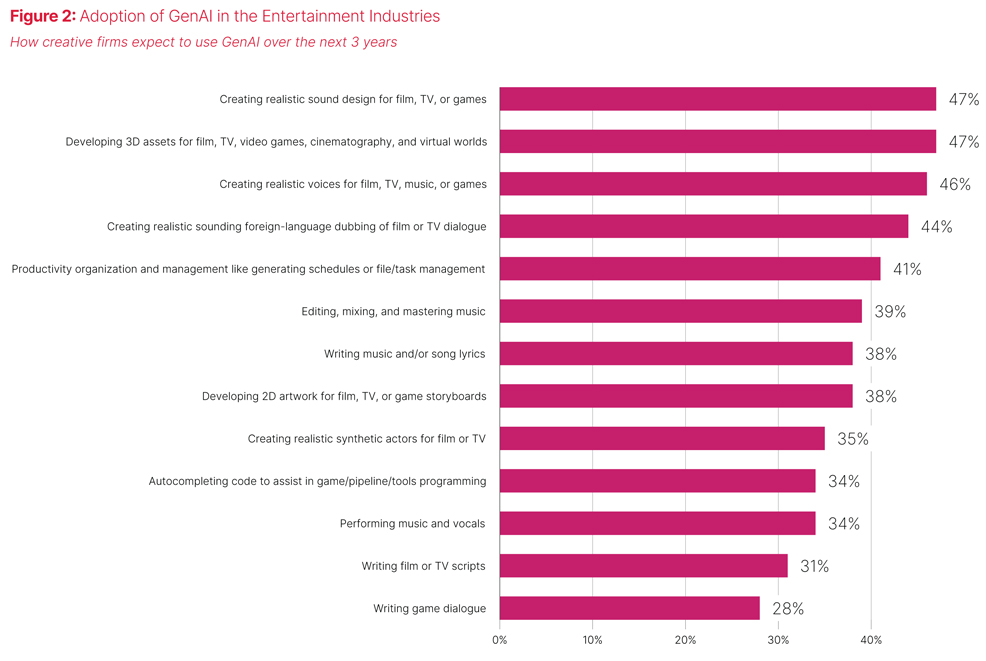
• Almost half (47%) of business leaders are expecting to use generative AI for creating 3D assets, as well as realistic sound design for film, television, and video games, over the next three years. Many other tasks will integrate generative AI, as shown in the figure below.
"In mid-2023, just months after OpenAI released ChatGPT, the Writers Guild of America (WGA) and Screen Actors Guild–American Federation of Television and Radio Artists (SAG-AFTRA) voted to go on strike," the report's authors write. "A point of contention for both unions lay in the impact that artificial intelligence (AI) would have on the nature of work and job security as the technology becomes more powerful and sophisticated. Many companies were already drawing on original content produced by writers to train developing generative artificial intelligence (GenAI) programs and/or using the likenesses of actors to generate digital replicas and character designs. Without strong protections in place, striking workers could envision a world in the not-too-distant future where their roles would be replaced by GenAI technology."
Additionally, the authors point out the interesting parallels between what is happening now, and some of the previous disruptions that have occurred since the Industrial Revolution. For example, the share of Americans working in agriculture stood at 50% in 1870. The introduction of mechanisation dropped that number to 41% by 1900 and just 2% by 2020. Manufacturing jobs have undergone a similar decline, in part due to progress in automation since the 1980s.
"With the emergence of generative AI, we come to another critical inflection point in the story of jobs and technology," they write. "The entertainment industries are in a period of significant uncertainty, where the nature of work is rapidly – and in many cases, profoundly – changing at an unprecedented rate."
Indeed, the market for generative AI appears on track for explosive growth. Bloomberg Intelligence, for example, predicts a compound annual growth rate (CAGR) of 42% over the next decade, with potential to exceed $1 trillion by 2031.
By www.futuretimeline.net