A new report warns of potentially major disruption to UK employment from the coming wave of AI. An estimated 11% of tasks are already exposed to current AI, a figure that could rise to 59% during a second wave. But there could also be opportunities for economic growth.
From the discovery and use of fire in the Stone Age, through to the handheld smartphones of today, technology has improved our living standards and is the foundation of modern society. Yet unmanaged technological change comes with risks and disruptions. The current wave of technology including generative AI – described by some as the "Fourth Industrial Revolution" – promises transformative benefits, while at the same time bringing potential disruption through its impact on wage inequality, wealth inequality, and job displacement.
The Institute for Public Policy Research (IPPR), based in London, this week published a first-of-its-kind analysis of generative AI and its consequences for the UK employment landscape. The report, available to download here, warns that the labour market is approaching a pivotal moment, with possibilities for widespread job disruption in the future but also GDP gains, depending on government policy.
Two key stages of adoption are identified: the first wave, which is here right now, and a second wave in which companies will integrate existing AI technologies further and more deeply into their processes.
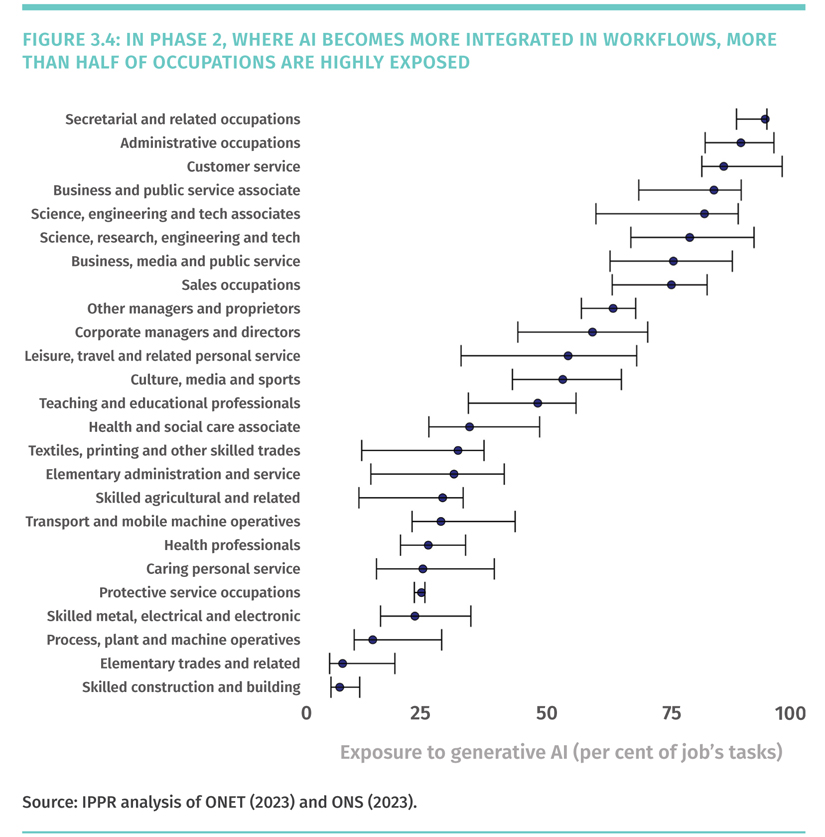
The report is a highly detailed analysis of 22,000 tasks in the UK economy, covering every type of job. It finds that 11% of tasks done by workers are already exposed in the first wave. It identifies 'routine cognitive' tasks (such as database management) and 'organisational and strategic' tasks (such as scheduling or inventory management) as most exposed to generative AI, which can both read and create text, software code and data.
However, this could increase more than five-fold, with AI doing 59% of tasks in the second wave. This would also impact non-routine cognitive tasks like creating and maintaining databases and would affect increasingly higher earning jobs.
Back-office, entry level, and part-time jobs are at the highest risk of being disrupted during the first wave. These include secretarial, customer service and administrative roles.
Women are more likely to be in such jobs, which means they will be among the most affected, the report says. Young people are also at high risk as firms hire fewer people for entry-level jobs and introduce AI technologies instead. In addition, those on medium and low wages are most exposed to being replaced by AI.
The IPPR has modelled three scenarios for the potential impact of "here and now" generative AI on the labour market, depending on policy choices:
• Worst-case scenario – full displacement: 1.5 million jobs are lost, with no GDP gains
• Central scenario – 545,000 jobs are lost, with GDP gains of 3.1% (£64bn per year)
• Best-case scenario – full augmentation: no jobs are lost, with GDP gains of 4% (£92bn per year)
Three scenarios for the "second wave" of AI adoption have also been modelled:
• Worst-case scenario – full displacement: all jobs at risk are replaced by AI, with 7.9 million job losses and no GDP gains
• Central scenario – 4.4 million jobs disappear, but with economic gains of 6.3% of GDP (£144bn per year)
• Best-case scenario – full augmentation: all jobs at risk are augmented to adapt to AI, instead of replaced, leading to no job losses and an economic boost of 13% to GDP (£306bn per year)
Screenshot of Copilot for Microsoft 365, a ChatGPT-based helper for automating tasks. Credit: Andreas Prott
Without government action and with companies left to their own devices, the worst-case scenario is a real possibility, the IPPR says. The institute is recommending that the government develop a "job-centric industrial strategy" for AI that encourages job transitions and ensures that the fruits of automation are shared widely across the economy. This should include:
• Supporting green jobs, as this sector is less exposed to automation than non-green jobs
• Fiscal policy measures, such as tax incentives or subsidies to encourage job-augmentation over full displacement
• Regulatory change, to ensure human responsibility of key issues, such as health
"Already existing generative AI could lead to big labour market disruption – or it could hugely boost economic growth. Either way, it is set to be a game changer for millions of us," said Carsten Jung, senior economist at the IPPR. "Many firms are already investing in it, and it has potential to speed up many more tasks as more businesses adopt it."
"Over the next five years it could transform knowledge work. The question now is less whether AI can be useful, but rather how fast and in what manner employers will use it. History shows that technological transition can be a boon if well managed, or can end in disruption if left to unfold without controls. Indeed, some occupations could be hard hit by generative AI, starting with back-office jobs."
"But technology isn't destiny, and a jobs apocalypse is not inevitable – government, employers and unions have the opportunity to make crucial design decisions now that ensure we manage this new technology well. If they don't act soon, it may be too late."
A sliding doors moment
"We could see jobs such as copywriters, graphic designers and personal assistants roles being heavily affected by AI," said Bhargav Srinivasa Desikan, co‑author of the report and a senior research fellow at the IPPR. "The question is how we can steer technological change in a way that allows for novel job opportunities, increased productivity, and economic benefits for all."
"We are at a sliding doors moment. Policy makers urgently need to develop a strategy to make sure our labour market adapts to the 21st century, without leaving millions behind. It is crucial that all workers benefit from these technological advancements, and not just the big tech corporations."
By FutureTimeLine